
Plan your Morocco adventure by matching your available vacation time to realistic routes—7 days covers the imperial cities circuit from Casablanca through Rabat, Meknes, Fes, and Marrakech, while 10-14 days allows you to add the Sahara Desert experience or coastal towns like Essaouira. Canadians typically visit during spring break (March-April) or summer holidays (July-August), though shoulder seasons offer better pricing and fewer crowds.
Start by determining your entry and exit cities based on direct flights from Toronto and Montreal—most travellers fly into Casablanca or Marrakech and follow either a circular route or a linear path between cities. Budget 4-6 hours for daytime drives between major destinations, booking private drivers or joining small group tours for routes like the Tizi n’Tichka pass to the desert, where public transportation becomes impractical.
Allocate your days strategically: dedicate 2 days minimum to Fes and Marrakech to properly explore their medinas, allow 2 nights for desert camps to experience sunset and sunrise over the dunes, and build in buffer time for Morocco’s relaxed pace—rushing between cities daily leaves you exhausted rather than immersed. First-time visitors should choose quality over quantity, thoroughly experiencing 4-5 destinations rather than superficially touching 8-10 locations.
Expect to spend $150-250 CAD per person daily for mid-range travel including accommodation, meals, and transportation, with costs decreasing significantly when travelling as a couple or group sharing drivers and riads.
How to Choose the Right Morocco Itinerary for Your Trip
Choosing the perfect Morocco itinerary starts with honest self-assessment and practical considerations. Since flights from Canada to Morocco typically involve at least one connection and take 12-16 hours, factor in jet lag recovery time—especially for your first day or two.
Your available vacation days shape everything. If you’re working with the standard Canadian two-week vacation, you’ll want a 10-12 day itinerary that accounts for travel days without feeling rushed. Weekend warriors with just a week should focus on one or two regions rather than attempting a whirlwind tour that leaves you exhausted.
Budget plays a major role in itinerary selection. Morocco accommodates both shoestring backpackers and luxury travellers beautifully. A budget-conscious trip might mean staying in riads and guesthouses, taking CTM buses between cities, and eating at local spots for CAD $75-100 daily per person. Luxury seekers choosing private drivers, upscale accommodations, and fine dining should budget CAD $300-500+ daily. Your spending comfort zone determines transportation choices, accommodation standards, and activity options.
Consider your physical fitness honestly. Desert camping, Atlas Mountain treks, and medina exploration involve considerable walking, often on uneven surfaces and steep stairs. If mobility is a concern, opt for itineraries emphasizing cultural sites with vehicle access and shorter walking distances.
Your interests should drive destination selection. Culture enthusiasts will prioritize imperial cities like Fez and Marrakech. Adventure seekers might focus on Sahara experiences and mountain trekking. Beach lovers should include coastal towns like Essaouira. Foodies will want extended time in culinary hotspots with cooking class opportunities.
Travel style matters too. Independent travellers comfortable navigating unfamiliar places can manage public transportation and self-guided exploration. First-timers or those preferring structure might invest in guided tours or private drivers, especially for challenging routes.
Finally, consider the six-hour time difference from Eastern Canada. Building in a gentle first day helps you adjust and actually enjoy your adventure from the start.
Classic 7-Day Morocco Itinerary: The Imperial Cities
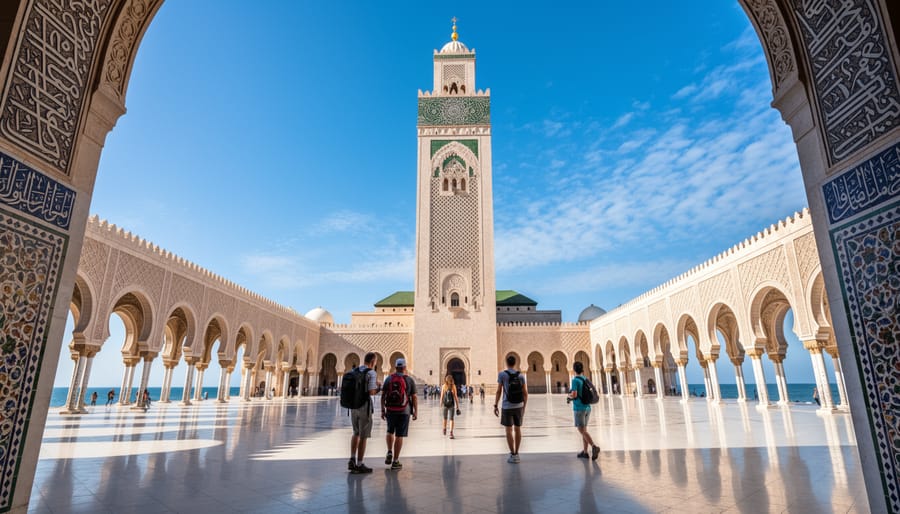
Transportation and Logistics
Getting between Morocco’s imperial cities is straightforward, with several transportation options to fit your budget and travel style. For most Canadian travellers, the train system offers the best value and convenience. The ONCF railway connects Casablanca, Rabat, Fez, and Marrakech with comfortable, punctual service. First-class tickets cost approximately $15-30 CAD between major cities, while second-class runs $10-20 CAD. Book tickets directly through the ONCF website or app, though walk-up purchases usually work fine outside peak holiday periods.
Private drivers provide flexibility for routes not well-served by trains, particularly to smaller destinations like Chefchaouen or desert towns. Expect to pay $80-150 CAD per day, which becomes economical when split among four travellers. Your riad can typically arrange reliable drivers.
Rental cars offer maximum independence and cost $40-70 CAD daily for compact vehicles. Canadian driver’s licenses are valid for short stays, though consider that Moroccan driving styles differ significantly from home. Road signage mixes Arabic, French, and occasionally English. Fuel costs roughly $1.30-1.50 CAD per litre.
For time-crunched visitors on typical one-to-two-week Canadian vacation allowances, combining trains for city-to-city transport with organized day trips maximizes efficiency without the stress of navigation.
Cost Breakdown for Canadians
Understanding what you’ll spend helps you plan confidently. Here’s what Canadians can realistically expect to budget for a Morocco trip.
Return flights from Toronto or Vancouver to Casablanca typically range from $800 to $1,400 CAD per person, depending on season and how far in advance you book. Flying during shoulder seasons (March-May, September-November) often yields better rates. From Montreal, you might find slightly lower fares, sometimes starting around $750 CAD.
Accommodation costs vary widely based on your comfort level. Budget riads and guesthouses run $40-70 CAD per night, mid-range options sit around $80-150 CAD, while luxury riads can reach $200-400 CAD nightly. Most Canadians find excellent value in the mid-range category.
Daily food expenses are pleasantly affordable. Street food and casual restaurants cost $10-20 CAD per person daily, while nicer dining experiences run $25-40 CAD. A week’s meals might total $150-250 CAD per person.
Activities and entrance fees are modest—expect $5-15 CAD for most attractions. Guided day tours range from $40-100 CAD depending on distance and inclusions.
For a comfortable 10-day trip, budget approximately $2,500-3,500 CAD per person (including flights), or $3,500-5,000 CAD for a more luxurious experience. Morocco delivers exceptional value compared to European destinations.
10-Day Morocco Adventure: Cities, Desert, and Coast
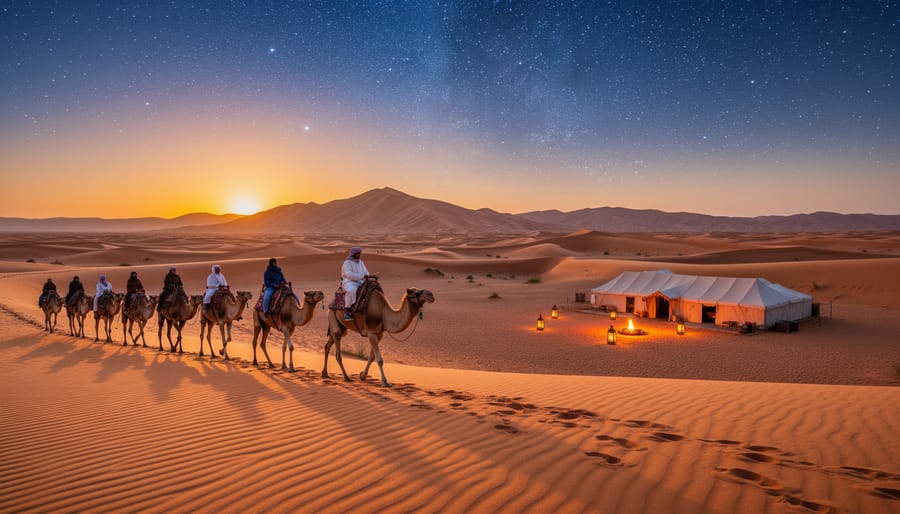
Sahara Desert Experience Details
The desert experience represents the highlight of most Morocco itineraries, but coming from Canada’s climate means you’ll need to prepare differently than you might expect. Sahara Desert tours typically depart from Merzouga or M’Hamid, with most Canadians choosing the Merzouga route from Fes or Marrakech.
Packing for the Sahara requires balancing extremes. While you’re used to layering in Canadian winters, desert nights from November to March can drop to 5°C, while days reach 25-30°C. Bring a warm fleece or down jacket, sunglasses, sunscreen (SPF 50+), a scarf for sun and sand protection, and closed-toe shoes for camel trekking. Skip the heavy winter boots you’d pack at home.
Choosing tour operators requires research. Look for companies with transparent pricing in Canadian dollars, confirmed pickup locations, and clear camp amenities. Read recent reviews from fellow Canadians about food quality, blanket warmth, and whether bathroom facilities meet your comfort level. Expect to pay between $85-200 CAD per person depending on camp luxury level.
Camel trekking typically lasts 1-2 hours each way to desert camps. The experience can be uncomfortable for those with back issues, so inquire about 4×4 alternatives. Camps range from basic Berber-style tents with shared facilities to luxury options with private bathrooms and proper beds. Most include dinner, breakfast, and evening entertainment around the fire. Bring wet wipes, hand sanitizer, and a headlamp for nighttime bathroom trips.
14-Day Grand Morocco Tour: The Complete Experience
Atlas Mountains and Berber Villages
The Atlas Mountains offer Canadian visitors an incredible escape from Morocco’s desert heat, with scenery that might remind you of the Rockies—though with distinctly North African character. You don’t need to be a mountaineer to enjoy this region; there are options for every fitness level.
For casual hikers, day trips from Marrakech to the Ourika Valley or Imlil village provide stunning mountain vistas without serious exertion. A guided half-day trek through terraced fields and walnut groves typically costs $40-60 CAD per person. If you’ve got moderate fitness, consider a two-day trek staying overnight in a Berber gite (mountain lodge). These authentic village homestays include home-cooked tagines and warm hospitality, running about $30-50 CAD per night with meals included.
More adventurous Canadians can tackle multi-day treks, including summiting Mount Toubkal (4,167m), North Africa’s highest peak. While no technical climbing skills are required, you’ll want proper acclimatization—similar preparation to hiking in the Canadian Rockies at elevation.
Spring (April-May) and fall (September-October) offer the best trekking conditions. Winter brings snow, making some trails inaccessible but creating beautiful scenery. Always hire local Berber guides—they’re knowledgeable, reasonably priced ($35-50 CAD daily), and your fees directly support mountain communities.
Chefchaouen and the North
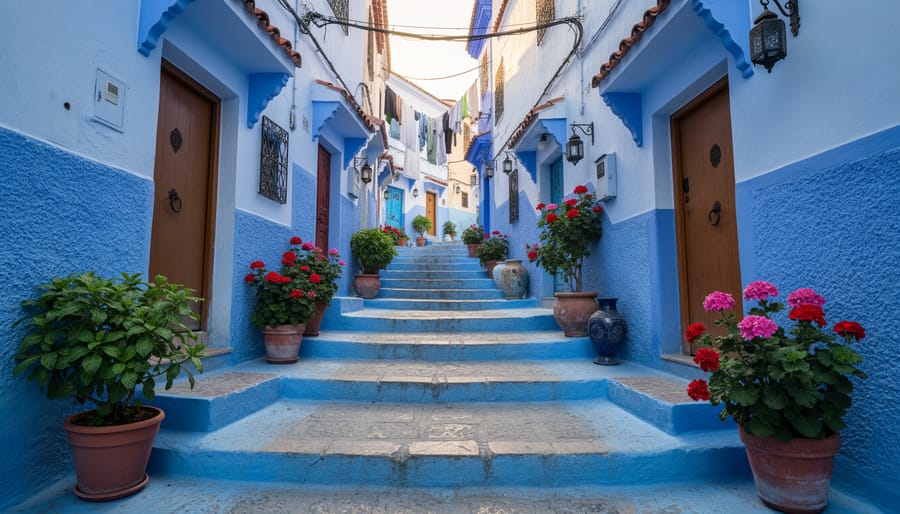
The enchanting blue city makes a wonderful addition to your Morocco itinerary, particularly if you have 10+ days to explore. Visiting Chefchaouen requires some extra planning since it’s tucked in the Rif Mountains, but the journey is absolutely worthwhile for that iconic blue-washed architecture.
From Fes, you can reach Chefchaouen in about 4 hours by CTM bus (approximately $10-15 CAD) or private transfer ($120-150 CAD). If you’re coming from Tangier, it’s just 2.5 hours away, making it perfect for those arriving via ferry from Spain or flying into Tangier’s airport—an increasingly popular option for Canadians connecting through European cities.
Most visitors spend 1-2 nights in Chefchaouen, which gives you plenty of time to wander the blue medina, enjoy the relaxed mountain atmosphere, and sample northern Moroccan cuisine. The town feels distinctly different from the imperial cities, offering a peaceful contrast to busier destinations.
Consider this northern route: Tangier (1 night), Chefchaouen (2 nights), then Fes (2-3 nights) before heading south. This works brilliantly with ferry arrivals or departures and showcases Morocco’s regional diversity beyond the typical southern circuit.
Weekend and Short-Stay Itineraries (3-5 Days)
With typical Canadian vacation time being precious, a long weekend or short stay in Morocco can still deliver an authentic experience if you focus on one region rather than attempting to cover everything. Many Canadians combine Morocco with European trips, making these shorter itineraries particularly practical.
The key to a successful short visit is managing your expectations and choosing a single base. Racing between cities eats up your limited days with transit time. Instead, pick one area and explore it thoroughly.
| Duration | Recommended Focus | Day Trips Possible |
|---|---|---|
| 3 Days | Marrakech only | Atlas Mountains or Essaouira (choose one) |
| 4 Days | Marrakech + surroundings | Both Atlas Mountains and Essaouira feasible |
| 5 Days | Fes + surrounding area or Marrakech with relaxation | Multiple day trips or coastal extension |
For a three-day Marrakech-focused trip, dedicate your first day to the medina, including Jemaa el-Fnaa square, the souks, and key sites like Bahia Palace. Day two could be a guided excursion to the Atlas Mountains, visiting Berber villages and enjoying mountain scenery that feels worlds away from the city chaos. Use your final day for the modern Gueliz neighbourhood, Jardin Majorelle, and any shopping you’ve been eyeing.
A four-day itinerary allows breathing room. You might add an overnight in Essaouira, the laid-back coastal town that’s a refreshing contrast to Marrakech’s intensity. The extra day also means you won’t feel rushed if you’re dealing with jet lag from your transatlantic flight.
Five days opens up Fes as an option. This ancient city receives fewer tourists than Marrakech but offers equally rich cultural experiences. Base yourself in Fes and take day trips to Meknes, Volubilis Roman ruins, and the blue city of Chefchaouen (long day trip or overnight recommended). Alternatively, use five days in the Marrakech region with a more relaxed pace, adding hammam experiences, cooking classes, or simply more time to wander without an agenda.
Winter visitors from Canada will appreciate Morocco’s mild temperatures during these months, though pack layers for cooler evenings. Book accommodations in advance, particularly if visiting during Canadian spring break periods when prices spike. Remember that Moroccan riads often have limited rooms, so popular properties fill quickly even for short stays.
Specialized Morocco Itineraries
Family-Friendly Morocco Itinerary
traveling Morocco with children requires thoughtful pacing and age-appropriate activities to keep everyone happy. Plan for shorter travel days—ideally no more than two to three hours between destinations—and build in downtime at your accommodations. Many riads in Marrakech and Fes feature inviting courtyards and small pools where kids can decompress after busy mornings exploring medinas.
Choose family-friendly riads with interconnecting rooms or suites, which are common and reasonably priced compared to Canadian hotel standards. Most riad owners are wonderfully accommodating with children and can arrange early dinners or simple meals like pasta if Moroccan cuisine proves challenging for picky eaters.
Focus on hands-on experiences: camel rides in the Sahara, pottery workshops in Fes, or cooking classes where kids can roll couscous. The Jardin Majorelle in Marrakech offers open space for restless legs, while beach time in Essaouira provides a relaxing counterpoint to cultural sightseeing.
Consider hiring private drivers rather than taking public transport—the cost is manageable when traveling as a family, and it eliminates stress around schedules and luggage. Most drivers are patient with frequent snack stops and bathroom breaks, understanding that family travel moves at its own rhythm.
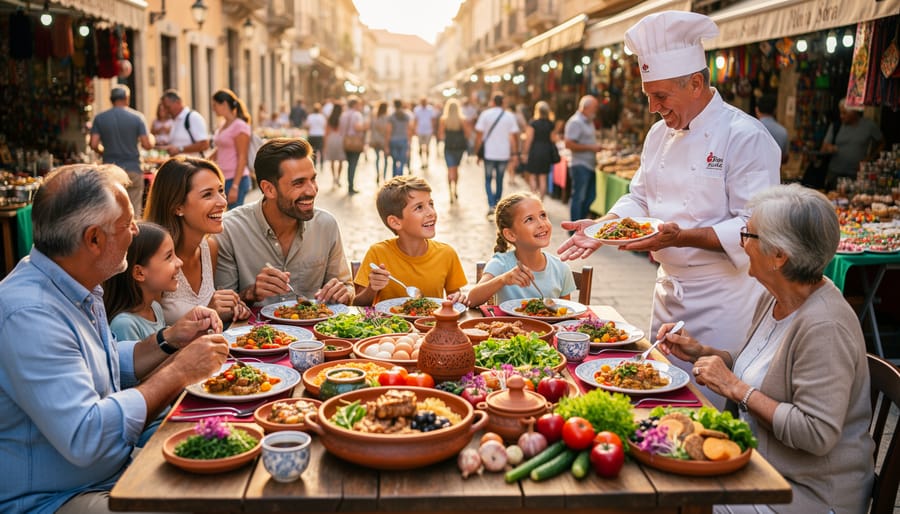
Seasonal Considerations for Your Morocco Itinerary
Timing your Morocco trip strategically can make the difference between a good vacation and an extraordinary one. The best time to visit depends heavily on what experiences you’re prioritizing in your itinerary.
For Canadian travellers, your typical vacation periods align differently with Morocco’s seasons. Christmas and New Year fall during Morocco’s cooler months, making this ideal for desert exploration and imperial city tours. The Sahara is comfortable during December and January, with pleasant daytime temperatures around 20°C and crisp evenings perfect for campfires under the stars. However, if your itinerary includes the Atlas Mountains, expect snow and potential road closures above 2,000 metres.
March Break coincides with Morocco’s shoulder season—arguably the sweet spot for balanced itineraries. You’ll encounter moderate temperatures, blooming almond trees in the valleys, and fewer crowds than peak spring. This period works beautifully for mixed itineraries combining cities, coast, and desert.
Summer holidays present more strategic considerations. Coastal destinations like Essaouira and Asilah shine during July and August, offering refreshing Atlantic breezes while inland cities swelter. If your itinerary focuses on Marrakech, Fes, or the desert, prepare for intense heat exceeding 40°C. Consider shifting these portions to early morning and evening, with midday breaks at your riad.
| Season | Weather | Crowd Level | Best Itinerary Focus |
|---|---|---|---|
| Dec-Feb | Cool, occasional rain | Moderate | Desert, cities, cultural festivals |
| Mar-May | Warm, pleasant | High | Atlas trekking, comprehensive tours |
| Jun-Aug | Hot inland, mild coast | Moderate-High | Coastal relaxation, northern cities |
| Sep-Nov | Warm, decreasing heat | Moderate | Desert, versatile itineraries |
Festival timing can enhance your itinerary significantly. The Rose Festival in May and the Gnaoua Music Festival in June offer cultural depth, though you’ll need to book accommodation well in advance. Ramadan shifts yearly and affects restaurant availability during daylight hours, requiring itinerary adjustments for meal planning.
Essential Planning Tips for Canadian Travelers
Planning your Moroccan adventure from Canada requires some specific preparation, but it’s quite straightforward once you know the essentials. Here’s what you need to know before you board that flight.
Getting there typically involves a connection, as there are no direct flights from Canada to Morocco. Air Canada, Royal Air Maroc, Air France, and Lufthansa offer excellent routing options through their European hubs. Most Canadians fly through Montreal, Toronto, or occasionally Paris or Frankfurt, with total journey times ranging from 12 to 16 hours depending on your departure city and layover duration. Booking at least two to three months ahead usually yields the best fares.
Good news on the visa front: Canadian citizens don’t need a visa for tourist stays up to 90 days. You’ll just need a passport valid for at least six months beyond your arrival date. Check the official Canadian passport and entry requirements before you depart to ensure you have everything sorted.
Travel insurance is absolutely essential. Look for policies that cover medical emergencies, trip cancellation, and lost baggage. Many Canadian credit cards offer travel insurance, but verify the coverage limits and ensure they’re adequate for Morocco. Medical facilities in major cities are good, but evacuation coverage provides peace of mind.
Regarding vaccinations, routine immunizations should be current, and Hepatitis A is recommended. Review the health precautions for Morocco with your doctor at least six weeks before departure. Tap water isn’t advisable for drinking, so stick with bottled water.
For currency, Moroccan Dirhams aren’t available in Canada, so plan to exchange money upon arrival at the airport or withdraw from ATMs, which offer competitive rates. Notify your bank before travelling to avoid card blocks. Most major credit cards work well in cities, though carry cash for smaller towns and souks.
Connectivity is easy and affordable. Purchase a local SIM card from providers like Maroc Telecom or Inwi at the airport or in city centres. Tourist packages offering several gigabytes of data typically cost 50-100 Dirhams (approximately 7-14 CAD). Ensure your phone is unlocked before leaving Canada. For more comprehensive guidance, check out our essential travel tips dedicated to Canadian visitors.
Customizing Your Morocco Itinerary
The beauty of planning a Morocco trip is that these itineraries aren’t set in stone—they’re templates you can adapt to match your travel style and interests. Most Canadians have limited vacation days (typically two to three weeks), so making every day count matters.
If you’re working with a shorter timeframe, consider removing less essential stops rather than rushing through everything. For a 10-day itinerary that includes the desert, you might skip Essaouira or Chefchaouen to maintain a comfortable pace. Conversely, if you have extra time, adding rest days in Marrakech or Fes lets you explore more thoroughly without the pressure of constant movement.
Swapping destinations works well when they serve similar purposes. You could replace Essaouira with Agadir for beaches, or substitute Chefchaouen with smaller Rif Mountain towns if you prefer fewer tourists. Just maintain logical routing—backtracking across Morocco wastes precious vacation time and increases costs.
Pacing is personal. Some travelers thrive on daily movement, while others prefer a home base approach with day trips. If you tire easily from travel days, consider staying three nights in major cities instead of two. Remember that Morocco’s winding mountain roads take longer than GPS estimates suggest.
Working with tour operators versus traveling independently depends on your comfort level. Private tours offer convenience, Canadian-friendly payment options, and eliminate language barriers, though they cost more. Independent travel using trains, CTM buses, and occasional private transfers gives you flexibility and cultural immersion at lower costs. Many Canadians find a hybrid approach ideal—booking desert tours and airport transfers while handling city exploration independently.
The key is honest self-assessment. Consider your energy levels, budget in Canadian dollars, interest in cultural immersion versus comfort, and tolerance for uncertainty when customizing your perfect Morocco adventure.
Choosing the right Morocco itinerary ultimately comes down to your personal travel style, how much time you can take off work, and what experiences matter most to you. Whether you have a long weekend or a full three weeks, Morocco offers incredible diversity that can fit almost any vacation schedule Canadians typically work with.
Use these detailed itineraries as your foundation, but don’t feel locked into following them exactly. Some of the best travel memories come from unexpected detours—a recommendation from a fellow traveller at your riad, an extra day in a city that captured your heart, or a festival you didn’t know was happening. Build in some flexibility where you can.
The good news for Canadian travellers is that Morocco is remarkably accessible. Direct flights from Montreal and Toronto make getting there straightforward, costs are generally favourable when converting from Canadian dollars, and the tourism infrastructure is well-developed while still offering authentic experiences. The country welcomes visitors warmly and caters well to international travellers without losing its distinctive character.
Now’s the time to start planning your Moroccan adventure. Pick the itinerary length that matches your available vacation days, adjust it to reflect your interests, and get ready for an unforgettable journey.